
India's leading IT companies are anticipated to report subdued revenue growth and largely stable margins for the July-September quarter, as clients maintain tight discretionary budgets, with analysts closely watching the conversion of strong bookings into revenue and the impact of AI on traditional services.
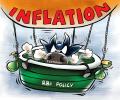
The Reserve Bank of India on Thursday marginally lowered its inflation projection for the current financial year to 5.1 per cent, as Governor Shaktikanta Das said the central bank's monetary policy actions are yielding the desired results. In April, the Reserve Bank had estimated the consumer price index (CPI) based retail inflation at 5.2 per cent during the fiscal 2023-24. CPI inflation fell sharply to 4.7 per cent in April 2023, from 6.4 per cent in February, on the back of favourable base effects, with softening observed across all the three major groups.

India's finance ministry anticipates inflation will remain relatively contained in the coming months, supported by a correction in crude oil prices and softening input costs following the cessation of the West Asia conflict, despite earlier spikes in wholesale and retail inflation.
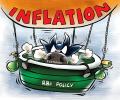
The Reserve Bank on Friday retained its inflation projection for current fiscal year at 6.7 per cent amid global geopolitical developments triggered by Russia-Ukraine war. RBI Governor Shaktikanta Das said the impact of inflation globally is weighing heavily on the domestic market. For September quarter of 2022-23, RBI projected retail inflation at 7.1 per cent.

The removal of Goods and Services Tax (GST) on individual health and life insurance has led to a significant increase in new policy purchases and higher coverage levels, despite an initial surge moderating, according to industry experts.

'They are claiming that they are very good in governance. All governments do propaganda. This is the propaganda of the government that they are doing very well, in spite of all the troubles.'
'They are claiming that they are very good in governance. All governments do propaganda. This is the propaganda of the government that they are doing very well, in spite of all the troubles.'

India is making a significant push to establish itself as a global semiconductor manufacturing hub, driven by strategic investments and policy support. The upcoming SEMICON India 2026 event will showcase the country's advancements and ambitions in this critical industry, which underpins virtually all modern electronic devices and has faced global supply chain vulnerabilities.

Reserve Bank on Thursday retained the growth and inflation projection at 7.2 per cent and 4.5 per cent respectively for the current fiscal amid expectations of a normal monsoon. In its last bi-monthly monetary policy review in June, RBI had projected real GDP growth and retail inflation at the same.

The Reserve Bank of India (RBI) Governor Sanjay Malhotra is now confronting the classic growth-inflation tradeoff, a situation exacerbated by the West Asia war, which threatens to end the 'goldilocks period' of low inflation and robust growth.

Analysts predict that inflation data, the US Federal Reserve's interest rate decision, and crude oil price trends will be the primary factors influencing the movement of Indian stock markets. Geopolitical developments, particularly the US-Iran deal, and foreign investor activity will also play a crucial role.
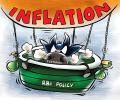
The Reserve Bank of India on Friday retained its projection for retail inflation at 4.5 per cent for the current fiscal assuming a normal monsoon, while emphasising that uncertainties related to food price outlook warrant a close monitoring. Consumer Price Index (CPI)-based retail inflation has been projected at 4.5 per cent with quarter-wise projections at 4.9 per cent in Q1 (April-June), 3.8 per cent in Q2, 4.6 per cent in Q3, and 4.5 per cent in Q4.

The Centre has spent 28 per cent of its FY27 capital expenditure budget of Rs 12.21 trillion in the first three months against around 24.5 per cent during the corresponding period a year ago.

Retail inflation inched up to 0.71 per cent in November on rising prices of vegetables, protein-rich items, and fuel, government data showed on Friday. The consumer price index (CPI)-based retail inflation had fallen to a record low of 0.25 per cent in October, mainly due to lower prices helped by GST rate cuts and a favourable base.

Start SIPs early, increase investments steadily, and let compounding beat inflation to secure retirement wealth, says Ramalingam Kalirajan

India's cement industry is on the brink of an oversupply situation as aggressive capacity expansion by major players is set to outpace demand growth over the next two financial years, potentially leading to pricing pressures and moderated utilisation rates.

India's retail inflation, measured by the Consumer Price Index (CPI), increased to 3.48 per cent in April, up from 3.40 per cent in March, primarily due to a surge in prices of gold and silver jewellery, as well as certain kitchen staples like tomatoes and cauliflower.

Voltas has announced a joint venture with Atomberg Innovation to manufacture high-efficiency room air conditioner (RAC) compressors, aiming to strengthen localisation and supply-chain resilience. Despite significant volume growth in RACs, the company's margins remain a key concern for analysts.

Dabur India reported a steady performance in Q1 FY27 with 10.6 per cent year-on-year revenue growth, a 12-quarter high, driven by broad-based gains across India and international businesses. However, volume growth, particularly in beverages due to unseasonal rains, and concerns over monsoon impact on rural demand remain key challenges.

Urban Indian millennials are caught in an algorithmically amplified consumption spiral where social media normalises spending patterns that systematically undermine retirement security.

Gold and silver prices are anticipated to maintain a positive trajectory in the coming week, with market volatility expected to remain high due to ongoing developments in West Asia and upcoming global economic data, particularly the Federal Reserve's FOMC meeting minutes.
Wholesale price inflation extended upward momentum for the second straight month, recording at 0.83 per cent in December 2025, driven by an uptick in prices of food, non-food articles, and manufactured items on a month-on-month basis, government data showed on Wednesday. Wholesale Price Index (WPI)-based inflation returned to positive in December, after witnessing a deflationary trend in the previous two months.
The RBI on Friday retained inflation forecast for FY23 at 6.7 per cent amid uncertain price trajectory on "geopolitical shocks" and on hope that inflationary pressures would ease with pick-up in kharif sowing and supply chain improvements. In its previous monetary policy review in June, it had projected retail inflation for 2022-23 at 6.7 per cent, higher from 5.7 per cent forecast in April. The six-member Monetary Policy Committee (MPC) unanimously decided to raise the benchmark repo rate by a steep 50 basis points to 5.40 per cent with immediate effect to tame inflation while supporting growth.

Fitch Ratings has affirmed India's sovereign credit rating at 'BBB-' with a stable outlook, acknowledging robust growth prospects and strong external finances. However, the agency highlighted concerns over elevated government debt, lagging structural metrics, and potential fiscal spending pressures due to rising youth unemployment.

Prime Minister's Economic Advisory Council (PMEAC) Chairman C Rangarajan may have found the Reserve Bank of India (RBI)'s inflation projections on the higher side, but independent experts agree with the central bank and expect both wholesale and retail prices to remain high.

Indian stock market indices closed on a mixed note, with the Sensex gaining 374 points driven by buying in Reliance Industries and ICICI Bank, while the Nifty remained flat. This divergence is attributed to a new Closing Auction Session (CAS) mechanism introduced by stock exchanges, impacting market liquidity and price discovery.

Sardar 2 has the interesting spy games, but too many convenient shortcuts and a tedious runtime leave this sequel struggling to match the crisp, engaging original, argues Sreeju Sudhakaran.

If you do not insulate your retirement corpus from the true cost of modern critical care, you don't have a retirement plan -- you have a fragile strategy waiting for an expensive medical emergency to break it

'If the war continue for a longer period of time, it is just a matter of time before the government will pass on some of the price increases.'

Wholesale price inflation (WPI) came in at (-) 0.32 per cent in November, driven by an uptick in prices of food articles like pulses and vegetables on a month-on-month basis, government data showed on Monday.

Reserve Bank Deputy Governor S C Murmu has highlighted the "cash paradox" where currency in circulation continues to grow despite a significant increase in digital payments. This trend complicates the RBI's forecasting and planning for currency production and distribution, prompting the central bank to seek solutions and explore ways to extend banknote life and reduce the carbon footprint of the cash cycle.

Moody's Analytics predicts India will remain the fastest-growing major economy in 2026 and 2027, but its pace will moderate due to a global slowdown, geopolitical risks, and financial market volatility, despite the boost from AI demand.

India's manufacturing sector activity growth declined to a five-year low in July, with the HSBC India Manufacturing Purchasing Managers' Index (PMI) falling to 53.5 from 54.2 in June, driven by a slower rise in new business orders and challenging market conditions.

'The MPC is likely to prioritise the key mandate, which is inflation, while relying on other instruments to stabilise the currency and bond markets.'

Indian benchmark indices Sensex and Nifty closed marginally lower due to profit-taking, following the Reserve Bank of India's decision to keep the repo rate unchanged while lowering its growth expectations for the current fiscal year and forecasting higher inflation.

S&P Global Ratings projects India's economic growth to slow to 6.6 per cent in FY27, down from 7.7 per cent in FY26, citing energy stress and a potential sub-par monsoon.

From tender romances to deeply conflicted relationships, these 10 films showcase Mammootty's softer, more vulnerable side at its most memorable.

A prolonged supply shock can transmit to lower incomes, and dampen confidence and sentiment, warns Aditi Nayar, chief economist, head-research and outreach, ICRA.

A recent SBI Economic Research report indicates that the significant gap between credit and deposit growth, currently over 530 basis points, is likely to persist if geopolitical risks and external supply shocks continue. However, an improvement in deposit growth is anticipated with inflows into foreign currency non-resident (bank) deposits.
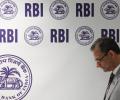
Uncertainties stemming from the West Asia crisis and its potential impact on inflation and economic growth were key factors in the Reserve Bank of India's Monetary Policy Committee (MPC) decision to maintain the status quo on interest rates, according to the recently released MPC meeting minutes.
